10x Finisher Chuck Petersen on Running the Vermont 100
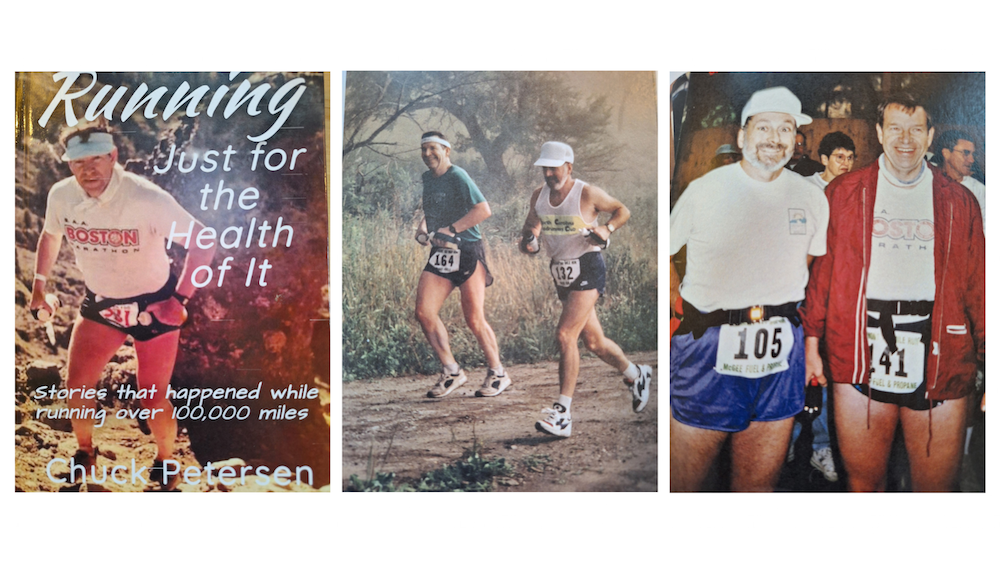
Photos: (1) The cover of Chuck’s book. (2) Chuck and his friend Joe running the Vermont 100 together in 1995. (3) Joe and Chuck at the start of the Vermont 100. Year unknown.
Note: The Vermont 100 has been given permission from Chuck Petersen to share the following an excerpt about the Vermont 100 from his book, “Running Just for the Health of It“. Thanks, Chuck!
About Chuck: He is an experienced ultra-runner and 10x VT100 finisher. He began running in the late 1970s and has since logged in over 100,000 miles on the roads and trails. Chuck maintains that keeping active, especially in older years, and running just for the health of it has made a positive impact on his life.
“When I ran the Western States 100 in 1989, my running buddy, Joe Lugiano, ran in the very first Vermont 100-mile race that year. The race was organized as a fundraiser for Vermont Adaptive Ski & Sports and, to this day, continues in that capacity.
In that first year, there were 114 runners and Joe was one of those who started and finished the race. Race Director Laura Farrell, was one of the runners in that first race and coninuted in the director’s position for many years thereafter.
Originally, the race was to be a 100-mile horse race to begin and end at the Smoke Rise Farm owned by Steve and Dinah Rojek. They were avid endurance horse racers. Steve was one of the top endurance riders in the country. I am told that Laura once competed and finished that race on her donkey. Then Steve, knowing that Laura was also an ultrarunner, offered her an opportunity to complete in the race on foot. Laura took him up on the offer and the tradition began. For some time, the race was limited to about 350 runners, about all the facility and trails could handle.
Today, the Vermont 100 Endurance Race is one of the premier ultra races in the country. After outgrowing its Smoke Rise Farm location, it now starts and finishes at Silver Hill Meadow in West Windsor, VT.
But, from 1989 until 2004, the race started and ended at Smoke Rise Farm, a beautiful setting on a dirt road where the nearest town is Woodstock, VT. On the property was a beautiful horse barn where runners met to sign in and have their pre-race physical which consisted of recording their weight and blood pressure.
The barn was lined with white pine and looked like a picture postcard. Next to the barn was a separate building housing the Rojeks’ vintage horse carriages. There were also stables and stalls inside for each of the horses. On race day, the horses were also given a physical, although I’m not sure exactly what that entailed.
The next morning, all runners assembled at the barn for their 4am start. Once checked in, runners were directed to walk from the barn down past the homestead to the dirt road and the start line. As they walked, a man in a tuxedo sat at a piano on the homestead porch and played “Chariots of Fire”.
At 4am a gun was fired, and the runners were off. At 6am, all the horse riders started out and covered the same course as the runners. The entire race ended back at the Rojeks farm where runners, riders, and their guests were treated to a wonderful grilled chicken lunch. It was a great way to cap off a wonderful event before all runners and guests departed for home, each carrying with them memories of the trails.
The Course
The Vermont 100 course was not a point-to-point one like Western States. Instead it covered several loops almost forming a clover leaf as it went up and down various mountains in the area. The mountains were not as steep or as prevalent as those at Western States, but many were very challenging.
Along the way, there were at least twenty aid stations allowing runners to minimize fluids they needed to carry along the trail. Many aid stations were accessible to the crew, but not all. It was a much easier race for a crew to manage because it did not have long drives between aid stations as required at Western States. However, that often meant that crews had longer waits.
Many stations were manned by volunteers. A few were just tables loaded with fluids and snacks. Some of the manned aid stations were theme oriented. In later years when I ran, I remember one particular aid station called “Margaritaville”. Crew members awaiting the arrival of their runners were often treated to margaritas, which sometimes caused problems for them having the correct items ready as their runners arrived.
Ten Bear was the name of the only aid station where all runners visited twice during the race. Runners coming through the first time usually looked energetic. That was not always the case on their second visit. There were also two medical checkpoints during the race. At those locations, weight and blood pressures were checked. The checks gave medics a chance to interface with each runner which was the most important purpose of the check. It was easy for a trained medic to identify someone who needed to take a break for a while.
This being a race where horses ran a similar, bur separate, simultaneous race was why the horses also had medical checks. I believe there were two “hold and checks”. Horses were given a more thorough physical than runners received. The rider was also quizzed about the horse’s condition. The horse was then cooled off, put in pasture for an hour, then re-saddled, rechecked, and released. If the attending vet deemed the horse to have any issues, the horse was pulled from the race regardless of what the rider might have said.
Unfortunately, runners don’t always get the same care. We’re supposed to have our own “horse sense” and know when it is not our day. However, we runners are more often “donkeys” about things like that than we are “horses”.
As previously mentioned, my training buddy Joe Lugiano ran the first Vermont 100 in 1989 and the second one in 1990 as well. After running Western States in 1989, I was not sure if I would ever run another 100 miler. It was not until Joe began training for the 1991 Vermont 100 miler than I began to consider doing another one myself.
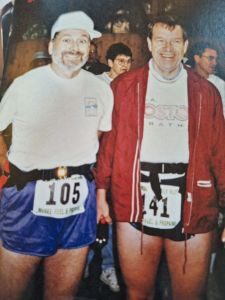
It would be great to do one with Joe, I thought. I would be doing most of the training with him anyway, so I might as well do the race too. So I signed up. And that began our almost fifteen years of running the Vermont 100. Most of the time we completed the race. On a few occasions, we fell short, but all were great experiences and I still covet the great memories that race has given me.
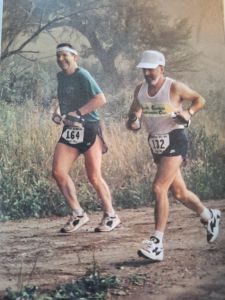
Over the years, I feel blessed to have finished ten Vermont 100 milers, most of which were with Joe by my side. Joe, himself, completed twelve Vermont 100s. Our last attempt was in 2006 when we both fell short of finishing. By then, we came to realize that staying on pace and within the check point time limits had become beyond our capabilities.”
Do you have a story from the early days of the Vermont 100?
We’d love to hear it! Email Race Director Amy Rusiecki.
